
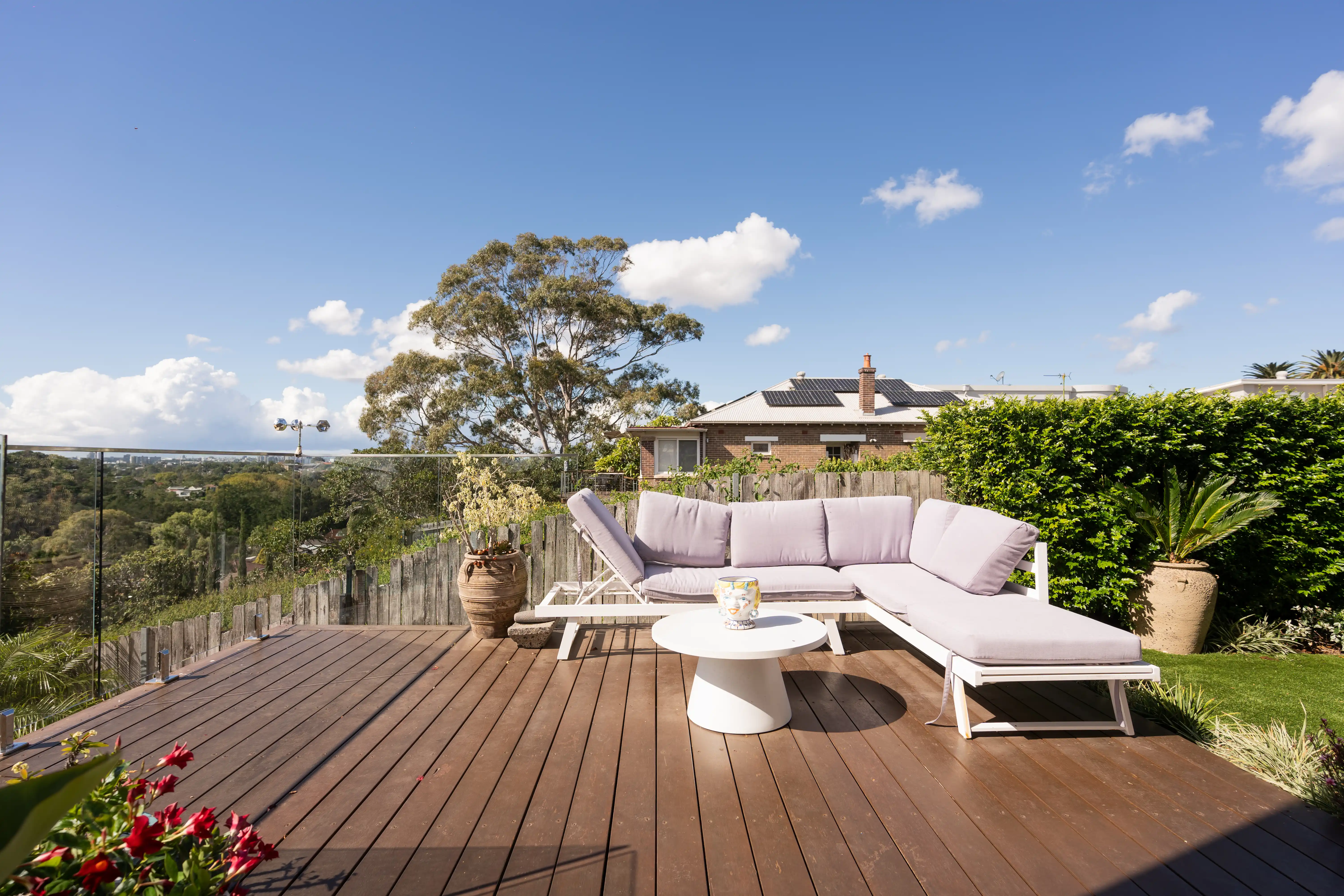
Decking projects vary widely in scope and complexity. The cost per square metre depends on your choice of materials, the size and shape of the deck, site conditions, structural requirements, and the finishes you select. This guide explains each factor so you can understand what drives the price and compare quotes with confidence.
Material choice: timber vs composite
The decking boards themselves represent a significant portion of the total cost. Hardwood timbers such as merbau, spotted gum, and blackbutt are popular in Sydney for their durability and natural appearance. Each species has different supply costs, hardness ratings, and maintenance requirements.
Composite decking, made from a blend of wood fibres and plastic, generally costs more upfront but requires less ongoing maintenance. Many composite products are designed to resist rot, termites, and fading, though performance varies between brands and product lines. It pays to compare product specifications and manufacturer documentation to understand what each product offers.
Softwood options like treated pine sit at the lower end of the price scale but may need more frequent sealing and have a shorter lifespan in exposed conditions. The right material depends on your budget, how the deck will be used, and how much maintenance you are willing to do.
- Hardwood timbers: merbau, spotted gum, blackbutt, ironbark
- Composite decking: lower maintenance, higher initial cost
- Treated pine: budget-friendly, more maintenance over time
Deck size and shape
Larger decks benefit from economies of scale in labour and material ordering, so the cost per square metre often decreases as deck size increases. However, the total project cost still rises with size.
Complex shapes, curves, and multiple levels add to labour time and material waste. A simple rectangular deck is generally more cost-effective than an irregular design with insets or angled edges. If your design includes built-in seating, planters, or privacy screens, these elements add to the overall price.
Site access and levels
The condition of your site has a direct impact on cost. Sloping blocks, limited access for materials, and the need to work around existing structures all increase labour time. A deck built at ground level on flat land is simpler than an elevated deck on a steep slope.
If materials cannot be delivered close to the build area, manual handling adds time and cost. Sites with restricted rear access, narrow side passages, or heritage overlays may require extra planning and careful logistics.
Demolition and removal of an existing deck, paving, or garden structures also factor into the quote. Some builders include this in their price, while others list it as a separate line item.
Substructure and framing
The framework beneath the deck boards is critical to longevity. Bearers, joists, and posts must be sized and spaced correctly for the span and load. The choice of framing material - treated pine, hardwood, or steel - depends on design loads, spans, treatment grade, exposure conditions, engineering requirements, and project brief. Each option suits different situations.
Footings depend on soil type and deck height. A ground-level deck on stable soil may use concrete pads, while an elevated deck on reactive clay may require deeper piers or screw piles. Engineering requirements, especially for decks over a certain height, can add to the cost.
- Treated pine framing: common and cost-effective for low decks
- Hardwood or steel framing: suited to longer spans, elevated builds, or specific engineering requirements - higher cost
- Footings: pads, piers, or screw piles depending on conditions
Railings, stairs, and balustrades
Elevated decks typically require balustrades for safety, and these must comply with Australian standards for height, gap spacing, and load resistance. Timber, steel, glass, and wire balustrades each have different cost profiles.
Stairs connecting the deck to the garden or lower level add to the build. The number of steps, width, and handrail requirements all influence the price. Wider stairs and custom designs cost more than standard configurations.
Finishes and additional features
Oil, stain, or paint finishes protect the timber and affect the final appearance. Some quotes include initial finishing, while others leave it to the homeowner. Composite decking does not require finishing but may have colour or texture options that vary in price.
Built-in lighting, power outlets, outdoor kitchens, and integrated planters increase the scope and cost. Drainage solutions, such as under-deck water management for elevated decks, add further complexity.
Approvals and compliance in NSW
In NSW, whether your deck requires approval depends on its dimensions, height above ground, setback from boundaries, and any planning overlays on your property. Some decks may qualify as exempt development under the State Environmental Planning Policy (Exempt and Complying Development Codes) 2008 if they meet all the standards set out in that instrument - including size limits, height thresholds, setbacks, and site constraints. Decks that do not meet every exempt development standard typically require a development application (DA) to council or a complying development certificate (CDC) from an accredited certifier.
Heritage conservation areas, bushfire-prone land, flood planning areas, and other site-specific constraints can impose additional requirements or exclude a property from exempt development pathways entirely. Your builder can advise whether your project is likely to need approval, but the final determination depends on the specific standards in the Codes SEPP and any local council controls. Application fees and any required engineering certification add to the project cost.
How to compare decking quotes
When you receive quotes from multiple builders, look beyond the bottom line. A lower price may reflect a smaller scope, different materials, or exclusions that will add cost later. A detailed quote helps you understand what is included and what is not.
Key items to compare include the decking material and grade, subframe materials, footing type, whether demolition and site preparation are included, the finish or coating, and whether balustrades and stairs are part of the price.
Ask whether the quote includes GST and whether there are any provisional or allowance items that could change. Check the payment schedule and what happens if variations arise during the build. A clear timeline with milestones helps you plan around the work.
- Decking boards: species, grade, profile, and source
- Subframe: bearer and joist sizes, spacing, material type
- Footings: type and number included
- Inclusions: demolition, site prep, finish, stairs, balustrades
- Exclusions: landscaping, electrical, plumbing, council fees
- GST: confirm whether the quoted price includes tax
- Timeline: estimated start and completion dates
Getting a quote for your deck
The best way to understand what your deck will cost is to speak with a builder who can assess your site, discuss your requirements, and provide a detailed proposal. Photos, measurements, and notes about access will help the conversation.
At Pro Deck Builders, we provide clear, itemised quotes for residential decking projects across Greater Sydney. We explain the options, outline what is included, and answer your questions before any work begins.
Frequently asked questions
Why do decking quotes vary so much between builders?
Quotes differ based on material choices, scope of work, subframe quality, inclusions, and the level of detail in the estimate. A lower price may exclude items that other quotes include, so it is important to compare like with like.
Does composite decking cost more than timber?
Composite decking typically has a higher upfront cost than treated pine and some hardwoods, but it requires less maintenance over its lifespan. The long-term cost depends on how you value time spent on upkeep versus initial investment.
Do I need approval for a deck in Sydney?
It depends on the deck dimensions, height above ground, setback from boundaries, and any planning overlays on your property. Some decks may qualify as exempt development under the NSW Codes SEPP if they meet all the relevant standards. Decks that do not meet every standard typically need a development application or complying development certificate. Check the official NSW Planning Portal and your local council early in the planning process.
What should be included in a decking quote?
A thorough quote should list the decking material and grade, subframe materials, footing type, any demolition or site preparation, finishes, balustrades, stairs, GST, and an estimated timeline. Exclusions should also be clearly stated.